Crests
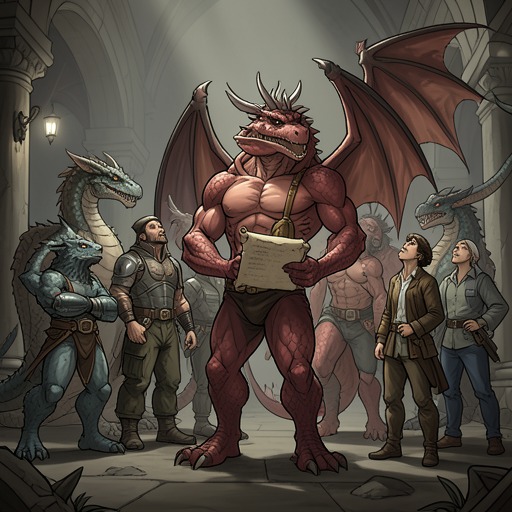
Vainqueur the DragonCrests are the decisive gatekeeping mechanism of the Class System: rare, powerful items that turn continued growth from an automatic reward into an achievement that must be earned and deliberately activated. Their importance becomes clear when Victor Dalton’s advancement through Monster Squire and Reaper, and Vainqueur Knightsbane’s own accumulation of power, meet the system’s hard limit. A Crest is not merely another treasure for a hoard; it is the permission to become something greater than an ordinary adventurer.
Definition and Function
Crests are powerful but rare items designed to break a class ceiling. The first ceiling appears at level 30. Once that threshold is reached, experience gains become zero and no additional levels can be obtained until a Crest is used, although special deeds can still grant perks. This distinction separates ordinary progression from exceptional advancement: effort alone no longer produces levels, and the system instead demands a specific object as the price of crossing the boundary.
The system describes Heroic Crests as even rarer and more powerful than ordinary Crests. They are required to break the level 60 class ceiling, establishing a hierarchy in which each stage of advancement demands a correspondingly more prestigious token. After the level 60 barrier is broken, a character may continue leveling to 99. That upper range opens access to Valhalla, the final challenge, and eventually to Apotheosis. The progression therefore links a tangible item to an escalating chain of class advancement, legendary status, divine trial, and possible deification.
The Level 30 Barrier
The first major encounter with the rule occurs after Victor Dalton receives substantial advancement. He initially gains a level in Monster Squire upon becoming the chief enforcer of Vainqueur Knightsbane, with the reward adding health, stamina, and increases across his attributes. Later, fearless leadership against superior opponents grants him seven more Monster Squire levels, the Monster Lifeforce (Red Dragon), Monster Rider, and Monster Insight Perks. His coup de grace against an ancient lich then grants two levels in Monster Squire and two in Reaper, along with Mook Promotion and Necromancy II.
These rewards show how the system translates service, combat, leadership, and cunning into measurable advancement. They also establish why the ceiling matters. Victor Dalton’s growth is not slow or symbolic; it arrives in large bursts tied to dangerous accomplishments, including trapping the lich’s soul in his Killer Scythe. Yet the same system that rewards those deeds eventually announces that level 30 is the maximum available without a Crest. The accumulation of power thus produces a new form of frustration: the more effective the character becomes, the more sharply the artificial boundary is felt.
The ceiling also exposes the system’s economic logic. Vainqueur Knightsbane interprets the need for a Crest as resembling a class structure in which advancement requires a special payment or privilege, likening it to the inequalities of Earth. The rule makes social hierarchy and game mechanics echo one another. A character can fight, serve, and achieve, but still remain formally blocked until the correct scarce resource is acquired.
Vainqueur Knightsbane’s Breakthrough
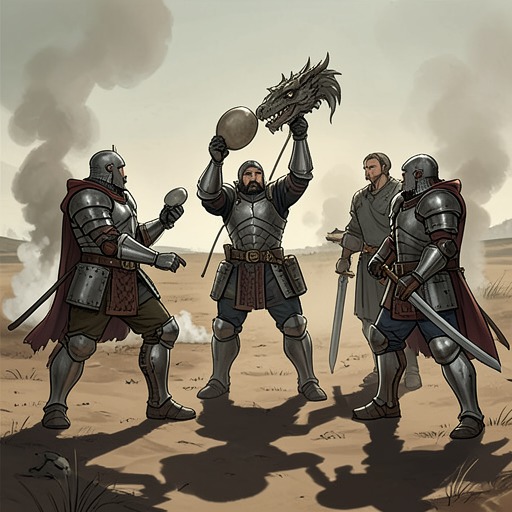
The concrete value of a Crest is demonstrated when Vainqueur Knightsbane defeats Brandon Maure and ends the threat posed by the Iron Eagle. The system calls the victory flawless and awards a Crest for the achievement. The item does not emerge as an ordinary drop discovered in a chest or recovered from a defeated enemy. A light descends from the heavens, and a golden, shield-like object floats before the dragon, covered in colored gemstones and beautiful enough to seem worthy of his hoard.
The presentation gives the Crest a double identity. Mechanically, it is a progression key. Visually, it is a magnificent treasure whose beauty appeals directly to Vainqueur Knightsbane’s defining obsession. His tear at the sight of it may have come from the item’s splendor or from the sand in his eyes, leaving the emotional response deliberately comic and ambiguous. Either way, the scene binds advancement to possession: the object is valuable because it changes his future, but it is also valuable because it looks like something his hoard should own.
The system asks whether the Crest should be used to break the class ceiling. Vainqueur Knightsbane answers affirmatively, and the object and surrounding light vanish immediately. The activation is instantaneous, but its consequence is permanent: the system confirms that he can now progress up to level 60. In addition, he receives the Crested Personal Perk, described as the transition from an ordinary adventurer to a folktale hero, with access to more prestigious classes. The Crest therefore changes not only a numerical limit but also the narrative category assigned to its user.
Progression, Status, and Consequences
The Crest system turns class advancement into a sequence of thresholds rather than a smooth climb. Before level 30, experience is sufficient to produce levels. At level 30, that mechanism stops. An ordinary Crest reactivates progress through level 60, but the next barrier demands a Heroic Crest. Only then can the character reach level 99 and attempt Valhalla. Each gate increases both scarcity and symbolic importance, so progression resembles a ladder of recognition as much as a record of strength.
The rule also preserves a distinction between perks and levels. Even after experience gains are reduced to zero at the ceiling, special deeds can still grant perks. This means the system does not render action meaningless; it redirects achievement away from routine numerical growth and toward exceptional abilities or status changes. The limitation creates pressure to seek the right breakthrough item while leaving room for characters to continue proving themselves through deeds.
At its highest stated horizon, the system connects Crests with the fate of Outremonde itself. Valhalla is presented as a final challenge from which only twelve creatures have survived and emerged as deities. The Crest is therefore the first visible link in a chain that extends from class restrictions to legendary heroism and, potentially, godhood. It does not guarantee Apotheosis, but without the successive breakthroughs it makes possible, that destination remains inaccessible.
The System’s Wider Meaning
Crests reveal the Class System as an active rule machine rather than a decorative fantasy vocabulary. It observes conduct, assigns levels and perks, imposes ceilings, and determines which objects can authorize further transformation. Vainqueur Knightsbane’s first class level comes through sheer ego and noble dragon bloodline, while Victor Dalton’s progression comes through service, leadership, combat, and tactical accomplishment. The same system can therefore convert radically different identities and actions into comparable advancement while still preserving distinct rewards.
The Crest also becomes evidence in the argument over whether the system exists. Icefang dismisses the idea of a system that grants power and money, insisting that its accessibility should make its reality demonstrable. Vainqueur Knightsbane’s visible success gives the claim social force, and Icefang eventually demands that the system appear before him. He then stops ranting and seems to look at invisible text, while the gathered witnesses fall silent and Vainqueur Knightsbane smirks in triumph. In this context, the Crest is more than a private upgrade: it is part of the system’s public proof, an object and rule capable of changing belief by producing visible consequences.
The resulting irony is central to the concept. The system promises meritocratic growth through deeds, yet it eventually requires rare items that not every achiever can simply obtain. A victory can earn a Crest, as Vainqueur Knightsbane’s defeat of Brandon Maure demonstrates, but the existence of the ceiling means achievement is never entirely self-sufficient. Crests make advancement spectacular precisely because they make it conditional: power is earned through action, suspended by an impersonal rule, and restored only through a rare token that transforms an adventurer into a figure of legend.